Play Longer
Pickleball Paddle Isometrics: Load the Shot That Hurts
A simple way to load an irritated tendon back to strength: recreate the exact pickleball shot that hurts, block the paddle with your other hand, and hold. The pain-gated method, the loading ladder, and how to start.
Back to Pickleball Injuries & Warm Up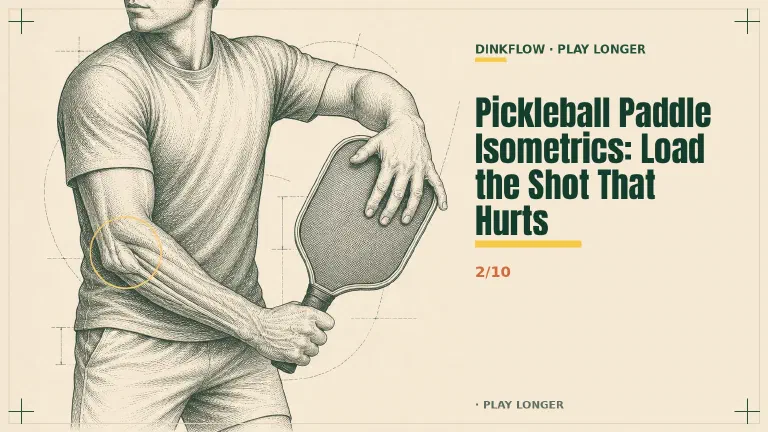
If one specific pickleball shot makes a tendon complain, that shot is telling you something useful. It is showing you the exact angle, grip, and force direction the tendon needs to tolerate. Paddle isometrics take that painful position, remove the speed and the ball, and turn it into a controlled load the tendon can actually adapt to.
The tool is the paddle you already own, plus your other hand. You freeze the shot, block the paddle so it cannot move, and press into it. That is an overcoming isometric, done in the precise position that matters for your game. This guide is the method; the pickleball elbow exercises page applies it shot by shot for the most common case.
Quick answer: A paddle isometric is a hold, not a swing. Recreate the shot that hurts (backhand slice, overhead, punch volley), block the paddle with your free hand, and ramp a slow push over about 3 seconds, hold around 30 seconds, ease off, rest, repeat about 4 rounds. Keep pain at 2 out of 10 or below during the hold and make sure the joint is no worse the next morning. This loads the exact tendon line pickleball irritates without the impact that flared it.
This is general educational information, not medical advice. If pain is sharp, spreading, or not improving, see a clinician.
What are paddle isometrics?
A paddle isometric is a static hold in a game position: you try to perform a shot while something stops the paddle from moving, so the muscle and tendon work hard but nothing actually moves. The “something” is usually your opposite hand gripping the paddle, though a wall, fence, or table edge works too. Because nothing swings, there is no impact, no follow-through, and no sudden jerk. What is left is the useful part: tension through the tendon at the exact angle your game loads it.
This is not a new idea about tendons. It is the loading approach that tendon researcher Dr. Keith Baar (University of California, Davis) describes for tennis elbow, applied to pickleball positions. What makes the paddle version practical is that you can do it anywhere, with no extra equipment, in the shot positions that actually created the problem.
Why the shot that hurts is the position to load
Tendons adapt to the specific direction they are loaded. Loading a tendon at one joint angle mostly strengthens it near that angle, which is why generic forearm exercises can leave the game-specific position still weak. When a particular shot hurts, it is pointing at the angle, wrist position, and force direction the tendon has lost capacity for. Recreate that position and you are loading exactly the fibers that need it.
So the painful shot is a map, not just a warning. You do not keep provoking it at full speed, which only re-irritates the tendon. You copy its position, strip out the speed and impact, and load it calmly. Same angle, less chaos.
The one rule that keeps it safe: pain
Pain is the dial that decides everything, and it has two parts:
- 2 out of 10 or below during the hold. A dull, working tension is fine. A sharp, specific, ice-pick pain is not; back off the force or the angle until it drops.
- No worse the next morning. This is the real referee. You can feel fine during a hold and still have done too much, so the honest test is how the joint feels the next day. If it is worse, the last dose was too big.
This one rule dissolves the usual “rest or load?” confusion. Early on, when even a light hold is over 2 out of 10, you simply back off that position. That is relative rest, not a sling: keep gentle, pain-free movement, and find the easiest version you can do under the limit (less force, an easier angle, resisting nearer the handle). As the tendon calms, the same position drops below the limit and you load it. Rest and load are not opposites here. They are the same dial read at different points.
The four-phase loading ladder
Isometrics are the entry point, not the whole journey. The recognized path back runs through four phases, each one gated by the pain rule above:
- Isometrics. Paddle held still in the game position. Calms the tendon and builds early tolerance. This is where you start.
- Strength through range. Slow, heavy, controlled movement once the holds are easy.
- Eccentrics and spring. Slow lowers and energy-storage loading to restore the tendon’s snap. This is the classic heavy-band work, placed here rather than first.
- Return to play. Shadow swings, then drop-fed balls, dinks, volleys, half-speed, and finally game speed.
You climb a rung only when the current one stays under the pain limit and does not flare the next morning. Most people spend the first week or two on rung one.
How to do a paddle isometric
- Find the position. Slowly move into the shot that hurts: same grip, same wrist angle, same elbow and shoulder position, same paddle-face angle. If moving into it already stings past 2 out of 10, ease off one variable until it settles.
- Block the paddle. Use your other hand on the paddle face or handle so it cannot move. A wall, fence, or table edge works if you want more resistance.
- Ramp slowly. Build force over about 3 seconds. No jamming or jerking into the hold.
- Hold. Around 30 seconds once you tolerate it. If 30 is too much, start at 10 to 15 and build.
- Ease off slowly, then rest about 2 minutes.
- Repeat about 4 rounds, keeping every hold at or below 2 out of 10.
A single-position session runs about 8 to 10 minutes (four rounds with the two-minute rests). If you rotate through several positions, give each 3 to 4 rounds and let the session run longer — do not trim the rests to fit, because those rests are part of what makes it work. You can load a given tendon up to about three times a day, leaving 6 or more hours between sessions on it: the loading signal fades after the first several seconds, and the tissue needs the gap to respond. These numbers — the 3-second ramp, roughly 30-second hold, 2-minute rest, four rounds, and the 2-out-of-10 ceiling — are DinkFlow’s synthesis of Dr. Baar’s public guidance and the tendinopathy pain-monitoring model (see the references), a practical starting point rather than a one-size clinical prescription; a clinician can tailor them to you.
Do you need to lift heavy? No
For rebuilding capacity, no. In a study Dr. Baar points to, rock climbers loaded their finger tendons at only about 40 percent of body weight, held for ten seconds, and gained just as much strength as people using much heavier loads. The hold, not the heavy weight, is what drives the adaptation. That is good news for a sore elbow: you can get a real strengthening signal without loading the joint hard.
Two things follow, and both matter more the older you are:
- Less soreness. Because the muscle is not lengthening under load the way it does in normal lifting, isometric holds cause far less muscle damage and next-day soreness. Older players, and anyone who gets wrecked by heavy lifting, tend to tolerate them well.
- They can calm the joint. Baar reports that a 30-second hold often eases pain in the joint for the next two to three hours. The evidence for this analgesic effect is mixed, so treat any relief as a bonus, not a promise — and if it does not show up, that is not a reason to press harder or keep loading.
None of this means load never matters. Building maximum strength and stiffness in a healthy tendon still rewards heavier work. But for the job here — rebuilding a grumpy tendon’s capacity without flaring it — light-to-moderate holds under the pain limit do the work.
Does collagen help?
A little, and only a little. Taking about 10 to 15 grams of hydrolyzed collagen or gelatin with 200 to 250 mg of vitamin C roughly 30 to 60 minutes before loading may give the tendon slightly better raw material during the window when loading drives repair. But the honest framing from the research is that the loading is the main event by a wide margin and the nutrition is a small helper. Do not treat a supplement as the treatment. If you skip it, the loading still does almost all of the work.
When to stop and see a clinician
Paddle isometrics are for the ordinary, grumbling overuse tendon. Stop and talk with a qualified clinician if any of these show up:
- Pain that is sharp at rest, or that wakes you at night
- Visible swelling
- Grip strength that drops noticeably (objects slipping from your hand)
- Numbness, tingling, or pain that radiates down the limb
- Symptoms that are the same or worse after two to three weeks of calm, pain-limited loading (and a hand-specialist question if they have not settled after six to eight weeks of conservative care)
These are assessment questions, not “load through it” questions.
Where to start
Start with the tendon that is actually barking. The elbow is the most common, and pickleball elbow exercises walks through the backhand-slice and overhead holds in detail. The same pain-gated method transfers to the shoulder on serves and overheads , and to the wrist on punch volleys and resets . The knee and Achilles use the same principle with a different setup — body-weight holds like the isometric squat and lunge Dr. Baar demonstrates, not a blocked paddle, since there is nothing to block a paddle against in a split-step or lunge. For upper-body overuse tendon pain the paddle recipe is the same: find the shot that hurts, freeze it, block the paddle with your other hand, and load it calmly under the 2-out-of-10 rule. Pain you cannot clearly pin on overuse — a joint that locks, gives way, swelled up suddenly, or started with a specific injury — is a different problem this method does not cover, so get that assessed before loading it.
Common questions
Are paddle isometrics the same as stretching?
No, and they do different jobs. Stretching lengthens the muscle and keeps the forearm loose and comfortable; it does not rebuild a tendon’s load capacity. Isometrics load the tendon so it gets stronger in the position you play. Do the stretch for comfort and the isometric for strength. On the pickleball stretches page, static stretching sits after play; isometric loading is separate work you build once a flare has calmed.
How hard should I press during the hold?
Hard enough to feel clear tension in the working tendon, but never past 2 out of 10 pain. A common starting point is a moderate press, maybe a third to half of your full effort, ramped in over about 3 seconds. If you cannot find a force that gives tension without sharp pain, the position is still too irritated; use an easier angle or wait a few days.
How often can I do them?
Up to about three times a day, with at least 6 hours between sessions on the same tendon. More often is not better: the tendon only takes in the signal for the first part of a hold, and it needs the gap between sessions to respond. Once daily is a fine starting point; add a second session only if the first stays quiet the next morning.
Isn’t pickleball elbow caused by gripping too hard? Why press hard on the paddle?
Both are true, at different moments. During play, a constant death grip on soft shots is wasted forearm load, so the in-game fix is a looser grip. Isometric loading is off-court, deliberate, brief, and pain-limited; it is the controlled dose that rebuilds capacity, not the all-session clenching that drained it. Loosen the grip when you play, and load the tendon on purpose when you train.
References
- Keith Baar, PhD, University of California, Davis, on isometric tendon loading and collagen timing (see The Tim Ferriss Show #797 and his UC Davis profile ).
- Keith Baar, PhD, 3 Isometric Exercises for Strengthening Tendons and Ligaments (UC Davis Health) — the lunge, squat, and push-up holds, and why light loads held for time build strength with little soreness.
- Pain-monitoring model for tendon loading (load to a tolerated pain ceiling, judged over 24 hours) — Silbernagel et al.
- Tendon loading continuum (isometric to isotonic to energy-storage) — Cook and Purdam
- Lateral elbow pain clinical practice guideline — Lucado et al. 2022
- AAOS OrthoInfo: Tennis Elbow (Lateral Epicondylitis)
- MedlinePlus: Tennis Elbow
- NIAMS: Sports Injuries