Play Longer
Pickleball Wrist Exercises: Isometric Holds for Punch Volleys and Resets
Isometric exercises for pickleball wrist pain that use your paddle. Recreate the punch-volley or reset position that hurts, block the paddle with your other hand, and load the wrist tendons under a low pain limit. Protocol, worked holds, and how to progress.
Back to Pickleball Injuries & Warm Up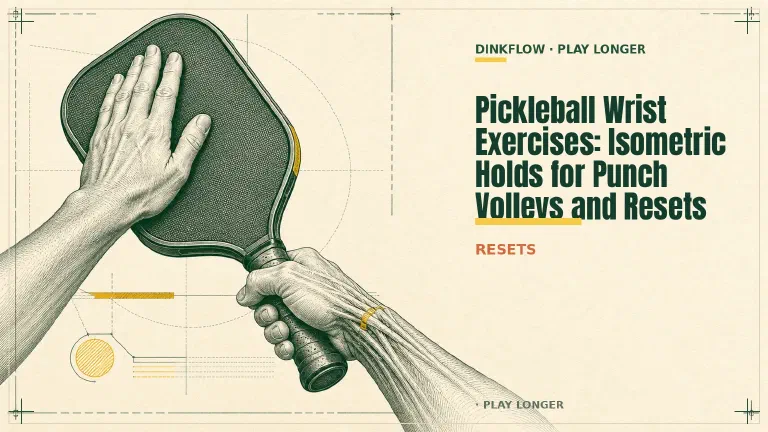
Pickleball asks a lot of the wrist. Punch volleys, quick resets at the kitchen, and the little wristy snaps players add to their shots all load the wrist tendons in fast, repeated bursts, and after a long open-play session that is where a nagging ache on the back of the wrist tends to show up. When that ache is overuse tendon pain — not one of the nerve, joint, or ligament problems covered further down — the approach is the same as for the elbow: load the wrist in the position the sport uses, calmly, with the paddle you already own.
This is the wrist-specific version of paddle isometrics . The wrist is upper body, so the paddle works as the loading tool, just like the elbow : you freeze the shot, block the paddle with your other hand, and press.
Quick answer: The best exercises for pickleball wrist pain are isometric holds in the position that hurts. Grip the paddle in your punch-volley or reset position, block the paddle with your free hand, and ramp a slow push over about 3 seconds, hold around 30 seconds, ease off, rest 2 minutes, repeat about 4 rounds. Keep pain at 2 out of 10 or below and make sure the wrist is no worse the next morning. Load the wrist in extension and in flexion, and progress the hold, then the angle, then strength.
This is general educational information, not medical advice. Numbness or tingling, pain after a fall, or a swollen wrist is a clinician question first.
What exercises help pickleball wrist pain?
For load-related pain around the wrist, the most useful exercise is an isometric hold in a position the sport actually uses. Tendons get stronger with the right load, and an isometric hold puts steady tension through the wrist extensor and flexor tendons without the fast snap that flared them. The punch-volley and reset positions are the ones that matter most for pickleball, because that is where the wrist has to stabilize the paddle against a quick load.
Loading a light position and holding it beats loading heavy: research Dr. Keith Baar points to found that a light hold held for time built as much strength as much heavier loading. So the goal is a calm, controlled hold, not a grind.
Before you start: the pain rule
Everything here is governed by one rule with two parts:
- 2 out of 10 or below during the hold. A dull, working tension is fine. Sharp, pinpoint pain is not; reduce the force or change the angle until it drops.
- No worse the next morning. The next-day check is the real test. If the wrist is grumpier the morning after, the last session was too much.
If a light hold is still over 2 out of 10, do not force it. Back off the punch volleys and wristy shots, keep gentle pain-free movement, and start with the easiest version you can do under the limit. That is relative rest, the first rung on the ladder.
The base protocol
- Ramp force over about 3 seconds, then hold about 30 seconds (start at 10 to 15 if 30 is too much)
- Ease off slowly, then rest about 2 minutes
- Repeat about 4 rounds, keeping every hold at 2 out of 10 or below
- You can do this up to about three times a day, 6 or more hours apart on the same wrist
These numbers are DinkFlow’s synthesis of Dr. Baar’s public guidance and the tendinopathy pain-monitoring model (see the references), a practical starting point rather than a personalized medical prescription.
Exercise 1: the resisted wrist-extension hold
The most common trigger, especially for players who snap wristy drives and punch volleys.
Setup. Hold the paddle in a normal grip with the wrist cocked slightly back, as if firming up for a punch volley. Bring your other hand onto the paddle face.
The hold. Try to cock the wrist further back into your blocking hand without letting the paddle move. Cue: press the wrist back, freeze the paddle. Ramp over 3 seconds, hold 30, ease off, rest 2 minutes, 4 rounds.
What it should feel like. Clear tension along the back of the wrist and forearm, dull and controlled, never sharp, never above 2 out of 10.
Exercise 2: the resisted wrist-flexion hold
For pain on the palm side, or to balance the extension work.
Setup. Hold the paddle in your normal grip, palm-side facing your blocking hand. Cradle the paddle face or handle with the other hand.
The hold. Try to curl the wrist forward into your blocking hand without moving the paddle. Same ramp, hold, rest, and rounds as the base protocol.
What it should feel like. Even tension along the palm side of the wrist and forearm, controlled and quiet.
Exercise 3: the punch-volley hold
The sport-specific one, for a wrist that complains during fast hands at the kitchen.
Setup. Take the paddle up into your punch-volley or reset position, matching the wrist and forearm angle you use in the shot. Block the paddle with your other hand.
The hold. Stabilize the wrist and press into the volley motion without letting the paddle move. Cue: load the volley, hold the wrist firm. Ramp, hold, rest, repeat.
What it should feel like. Tension in the same wrist area that complained during fast hands, controlled, with no sharp catch.
How to progress
Move up only when the current step stays under 2 out of 10 and the wrist is no worse the next morning. Change one thing at a time:
- Own the position. Start with shorter holds (10 to 15 seconds) and a strong assist from your blocking hand.
- Own the duration. Build to 30-second holds at the same, comfortable position.
- Own the angle. Edge the setup closer to your true punch-volley position.
- Add strength, then eccentrics. Bring in slow, controlled wrist curls and extensions through range — start light and build to heavier, slow loading as it stays under the pain limit (the heavy-slow phase) — then add eccentric lowers once that heavy-slow work is easy.
- Return to play. Shadow volleys, then soft drop-fed resets and dinks, then fast hands at controlled speed, then game-speed volleys.
The paddle isometrics pillar has the full four-phase ladder and the reasoning behind the order.
When to see a clinician
The wrist is full of small joints, ligaments, and nerves, so not every wrist pain is a tendon. Stop and get it assessed if you notice:
- Numbness, tingling, or pins-and-needles in the fingers
- Pain that came from a specific fall, twist, or wrench, or that comes with swelling
- Pain on the pinky side of the wrist when you rotate the forearm, or a click or catch
- Grip strength dropping noticeably, or the wrist feeling like it gives way
- Load-related pain that is the same or worse after two to three weeks of calm, pain-limited loading (or has not settled after six to eight weeks of conservative care, which is a specialist question)
Those are clinician territory, not “load through it” territory.
Where this fits
Start with the paddle isometrics method to see how the block-and-hold works, then use the three wrist holds above. The pickleball elbow exercises page runs the same paddle method for the outer elbow, which often flares alongside a wristy game, and the Play Longer hub ties the warm up, gear, and safer-play pieces together.
Common questions
What is the best exercise for pickleball wrist pain?
An isometric hold in the position that hurts: grip the paddle in your punch-volley or reset position, block it with your other hand, and press into it for about 30 seconds at 2 out of 10 pain or below, about 4 rounds. It loads the wrist tendons pickleball irritated, without the fast snap that keeps re-flaring them.
Is it wrist tendonitis or something else?
Not always. Load-related pain over the back of the wrist that flares with punch volleys, resets, and gripping is often the wrist tendons these holds are built for. But thumb-side pain in particular has its own causes (like de Quervain’s) that these general holds do not target, and numbness or tingling in the fingers, pain after a fall or wrench, pinky-side pain when you twist, or swelling are different problems. If you are unsure, or any of those are present, get it assessed before loading.
How long until a sore wrist settles?
It varies. A mild, load-related ache that gets reduced volume plus calm, pain-limited holds often quiets down in a few weeks. A wrist pushed through for months can take longer and may need clinician input. The next-morning check is your progress meter.
Can I keep playing pickleball while doing these?
Usually at reduced volume, with the load managed. Ease off the hard punch volleys and wristy snaps, keep sessions shorter, and do the holds off-court. If play keeps the wrist the same or worse the next morning, reduce volume further, and if it will not settle over two to three weeks, get it assessed.
References
- Keith Baar, PhD, University of California, Davis, on isometric tendon loading (see The Tim Ferriss Show #797 and his UC Davis profile ).
- Pain-monitoring model for tendon loading (load to a tolerated pain ceiling, judged over 24 hours) — Silbernagel et al. 2007, Am J Sports Med
- Tendon pathology continuum (reactive, disrepair, degenerative), the model behind load-based tendon rehabilitation — Cook and Purdam 2009, Br J Sports Med
- NIAMS: Sports Injuries
- MedlinePlus: Wrist Injuries and Disorders