Play Longer
Best Pickleball Paddles for Tennis Elbow: 7 Arm-Friendly Picks
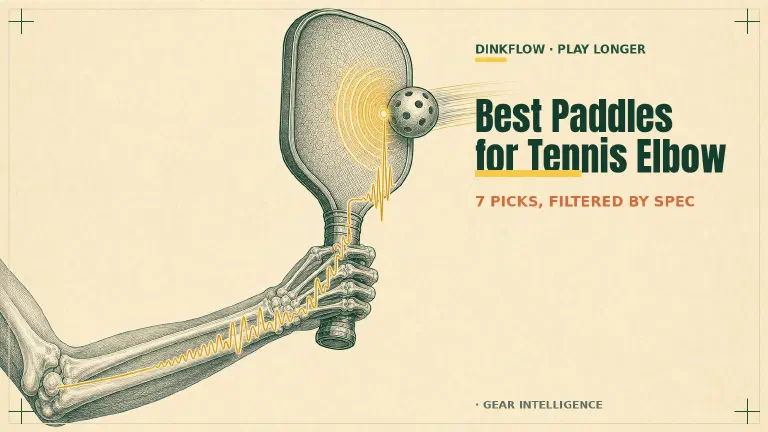
Seven arm-friendly pickleball paddles picked from the DinkFlow database by the specs that actually protect the elbow: 16mm cores, midweight builds, and balance that stays out of the head.
Back to Pickleball Injuries & Warm UpIf your elbow complains after pickleball, the paddle you swing on every shot is either helping or hurting. This list is different from most “best paddle for tennis elbow” roundups in one specific way: the picks come out of the DinkFlow paddle database by spec filter, not from affiliate deals or a brand’s press kit.
The filter is the one our paddle specs guide lays out in detail: a 16mm core (the single most predictive spec for arm comfort), a midweight build between 7.6 and 8.2 ounces (light enough not to fatigue, heavy enough that you don’t over-swing), and a balance point that is not head-heavy (the less mass out at the tip, the less your forearm fights on every swing). Of the 259 paddles in the database at the time of writing, 92 pass that filter. These seven are the strongest of them across different shapes and play styles.
One honest caveat before the list: face stiffness and construction (thermoformed vs. cold-pressed) also matter for arm comfort, and those don’t live in a spec table. Before you buy any paddle here, check the current listing for construction details — and if you already own a paddle close to these specs, read the tuning tips first. You may not need a new paddle at all.
This is a gear list, not a treatment plan. If your elbow hurts, start with the pickleball elbow guide — and a clinician if symptoms persist.
The seven picks
1. Vatic Pro V-Sol Pro Bloom — the recovery pick
Widebody · 7.9 oz · 16mm core · handle-friendly balance
The most handle-friendly widebody in the database that passes the filter. The widebody shape gives you the biggest usable sweet spot, which matters more for a sore elbow than any other shape trait: off-center hits are the single biggest tendon load in rec play, and a bigger sweet spot means fewer of them. Balance sits well away from the head, so the swing feels lighter than the scale weight suggests. If you’re mid-flare and still want to play, this is the profile to reach for.
Tuning tip: leave the tip alone. If you want more stability against drives, add lead at 3 and 9 o’clock only — it raises twist weight (mishits torque the wrist less) while barely moving balance. Specs and setups on DinkFlow →
2. Six Zero Coral Pro — the big-brand all-courter
Hybrid · 8.2 oz · 16mm core · neutral balance
Six Zero’s 2026 flagship line, and the easiest big-brand recommendation on this list: the Coral Pro pairs the plush, pace-absorbing feel the Coral family is known for with a hybrid shape that keeps some reach without going full elongated. It’s widely stocked, so you can usually try one before buying — and its elongated sibling passes this filter too if you want the extra reach (the widebody just misses on weight). One check for tournament players: early Coral Pro listings describe UPA approval, which is a different circuit from USA Pickleball — verify it on the official approved-paddle list before relying on it for sanctioned events.
Tuning tip: it ships on the heavier side of the window, so skip added lead and spend the effort on grip fit — the plush face does the shock absorption; your hand position decides how much of it you feel. Specs and setups on DinkFlow →
3. Bread & Butter Loco Hybrid — the down-the-middle all-courter
Hybrid · 8.0 oz · 16mm core · neutral balance
The Loco Hybrid sits squarely inside the arm-friendly weight window at 8.0 oz with a 16mm core and a hybrid shape, and its balance stays on the safe side of the line. Nothing about it is extreme, which is exactly the point for an elbow that punishes extremes.
Tuning tip: the neutral balance leaves headroom in both directions — a few grams at 3 and 9 for stability, or a light handle stack if you want it to feel quicker at the kitchen. Specs and setups on DinkFlow →
4. Pickleball Apes Harmony S — the stable widebody
Widebody · 8.0 oz · 16mm core · neutral balance
The second widebody on the list, for players who want maximum forgiveness with a touch more mass behind blocks. Same logic as the Bloom — big sweet spot, weight kept off the tip — with a feel that suits kitchen-line doubles players who mostly block, reset, and counter.
Tuning tip: widebodies already carry good natural twist weight; if the paddle feels stable, don’t tape it at all. A fresh overgrip sized to your hand does more for your elbow than lead. Specs and setups on DinkFlow →
5. 11SIX24 Vapor Power 2 — the 2026 foam pick
Hybrid · 8.0 oz · 16mm core · handle-friendly balance
Straight from the 2026 foam-core generation, and proof that it isn’t only about power: the Vapor Power 2 passes the arm-friendly filter outright — 16mm core, midweight, and a balance point at just 56.8% of length. Foam cores absorb impact by construction, which is exactly what a touchy elbow wants, and this one has built its reputation on keeping that feel as the paddle wears. Don’t let the name scare you; the specs are among the gentlest of the current foam wave.
Tuning tip: it ships balanced enough that most players shouldn’t tape it at all at first — play two weeks stock, then add small 3-and-9 amounts only if hard drives push it around. Specs and setups on DinkFlow →
6. Ronbus Quanta R1.16 — the light elongated
Elongated · 7.7 oz · 16mm core · neutral balance
Elongated shapes are usually the riskier call for a sore elbow — the length pushes mass away from your hand. If you won’t give up reach, the Quanta R1.16 is the elbow-conscious way to keep it: the lightest elongated build that passes the filter (a mark it shares only with its Quanta siblings), staying balanced away from the tip. A natural fit for singles players and tennis converts.
Tuning tip: do not add tip lead on this paddle while symptomatic — the elongated shape multiplies its swing-weight cost. Stability lead goes at 3 and 9, sized conservatively. Specs and setups on DinkFlow →
7. Honolulu J6CR — the friendlier elongated
Elongated · 8.0 oz · 16mm core · handle-friendly balance
The second elongated on the list, and the counterpoint to the Quanta: instead of going as light as possible, the J6CR keeps standard weight but carries one of the friendliest balance points of any elongated that passes the filter — the mass sits noticeably away from the tip. If the Quanta feels too feathery against hard drives but you still want reach, this is the shape-preserving compromise. (Its hybrid stablemate, the J2CR , passes the filter too — with an even friendlier balance — if you’d trade the reach for a bigger sweet spot.)
Tuning tip: its balance is already unusually kind for an elongated, so treat added weight as a last resort — check grip size and grip pressure first, and if you do add lead, keep it at 3 and 9 in small doses. Specs and setups on DinkFlow →
All seven at a glance
| Paddle | Shape | Weight | Core | Best for |
|---|---|---|---|---|
| Vatic Pro V-Sol Pro Bloom | Widebody | 7.9 oz | 16mm | Active symptoms, recovery |
| Six Zero Coral Pro | Hybrid | 8.2 oz | 16mm | Big-brand all-court |
| Bread & Butter Loco Hybrid | Hybrid | 8.0 oz | 16mm | Balanced all-court |
| Pickleball Apes Harmony S | Widebody | 8.0 oz | 16mm | Kitchen-line doubles |
| 11SIX24 Vapor Power 2 | Hybrid | 8.0 oz | 16mm | Modern foam feel, durability |
| Ronbus Quanta R1.16 | Elongated | 7.7 oz | 16mm | Reach without the whip |
| Honolulu J6CR | Elongated | 8.0 oz | 16mm | Reach with a stable feel |
Specs are pulled from the DinkFlow paddle database and reflect stock builds at the time of writing; models get revised, so treat the database page for each paddle as the current source.
Why specs beat models
Any of these paddles can still be wrong for you if the rest of the setup is wrong — and a paddle that isn’t on this list can be right if its specs land in the window. The durable checklist, from the full specs breakdown :
- 16mm core, cold-pressed or non-thermoformed construction where you can confirm it
- 7.6–8.2 oz static weight with a balance that is not head-heavy
- Twist weight raised with 3-and-9 lead tape rather than tip weight
- Grip built up to your actual hand size — most players are 1–2 sizes under
Run any paddle you’re considering through the Tuning System to see how a lead-tape plan changes its balance before you put money or tendon on it.
Common questions
Do I really need a new paddle for tennis elbow?
Often not. If your current paddle already has a 16mm core and midweight build, a grip size correction, a looser grip pressure, and 3-and-9 lead tape address most of the paddle-side load — at a tenth of the price. The paddle matters most when your current one fails the filter outright: 13mm core, over 8.4 oz, or clearly head-heavy.
What paddle spec matters most for tennis elbow?
Core thickness. A 16mm core deforms more on impact and absorbs vibration a thinner core sends into the handle. Weight and balance come next — together they set the swing weight your forearm fights on every shot. Face material matters too but is harder to compare from spec sheets.
Are heavier or lighter paddles better for tennis elbow?
Neither extreme. Under about 7.4 oz you over-swing to generate pace; over about 8.4 oz you over-grip and fatigue. The 7.6–8.2 oz midweight window with a non-head-heavy balance is the target — which is exactly how this list was filtered.
Can I keep playing pickleball with tennis elbow?
Usually at reduced volume, with the load managed — that’s a bigger topic than gear. The pickleball elbow guide covers the four levers (warm up, setup, technique, recovery) and the warning signs that mean stop and see a clinician.