Play Longer
Pickleball Elbow Exercises: Paddle Isometrics for the Shot That Hurts
Isometric exercises for pickleball elbow that use your paddle. Recreate the backhand slice or overhead that hurts, block the paddle with your other hand, and load the tendon under a low pain limit. Protocol, worked examples, and how to progress.
Back to Pickleball Injuries & Warm Up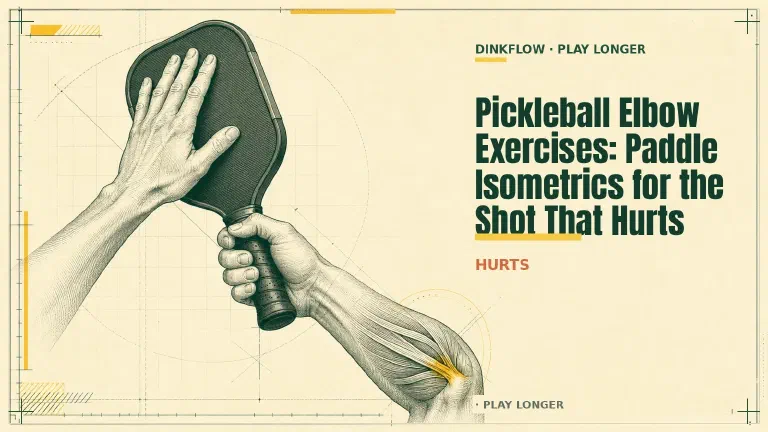
The most useful exercise for pickleball elbow is not a generic band curl. It is the exact shot that hurts, held still and loaded on purpose. If your backhand slice or overhead is what makes the outside of the elbow bark, that shot is showing you the precise angle the tendon needs to get stronger in. These exercises copy that position, take out the speed and the ball, and load it calmly with the paddle you already own.
This is the elbow-specific version of paddle isometrics . It pairs with the pickleball elbow guide , which covers grip pressure, paddle setup, and bracing; this page is the loading half.
Quick answer: The best exercises for pickleball elbow are isometric holds in the position that hurts. Freeze the backhand slice or overhead, block the paddle with your free hand, and ramp a slow push over about 3 seconds, hold around 30 seconds, ease off, rest 2 minutes, repeat about 4 rounds. Keep pain at 2 out of 10 or below and make sure the elbow is no worse the next morning. Progress the hold length first, then the angle, then heavier strength and eccentrics, then a graded return to play.
This is general educational information, not medical advice. Pickleball elbow that is sharp, swollen, or not improving is a clinician question.
What exercises actually help pickleball elbow?
Pickleball elbow is lateral epicondylitis: overuse of the forearm extensor tendons where they attach on the outside of the elbow. Tendons like that get better with the right kind of load, not with rest alone, and not with stretching alone. The right kind of load, especially early, is isometric: a hold that puts tension through the tendon without the impact that flared it.
The reason to use the paddle in a game position rather than a generic exercise is direction. A tendon adapts most in the angle it is loaded, so loading the exact backhand or overhead position rebuilds the capacity you actually lost. Generic wrist curls miss that angle. The painful shot does not.
Before you start: the pain rule
Everything here is governed by one rule with two parts:
- 2 out of 10 or below during the hold. Dull, working tension is the target. A sharp, pinpoint, ice-pick pain means back off the force or the angle.
- No worse the next morning. The next-day check is the real test. If the elbow is grumpier the morning after, the last session was too much; drop the force or the hold length.
If even a light hold in the game position is over 2 out of 10 right now, do not force it. Back off that shot, keep gentle pain-free movement, and start with an easier version (less force, a less-loaded angle, resisting nearer the handle). That is relative rest, and it is a rung on the ladder, not a detour.
The base protocol
Use this as the simple default for any of the holds below:
- Ramp force over about 3 seconds
- Hold about 30 seconds (start at 10 to 15 if 30 is too much and build up)
- Ease off slowly
- Rest about 2 minutes
- Repeat about 4 rounds
- Keep every hold at 2 out of 10 or below
One position with four rounds runs about 8 to 10 minutes. If you train more than one hold in a session, give each 3 to 4 rounds and let the session run longer — do not shorten the rests or skip rounds to fit a fixed time. You can do this up to about three times a day, 6 or more hours apart on the elbow. These numbers are DinkFlow’s synthesis of Dr. Baar’s public guidance and the pain-monitoring model (see the references) — a practical starting point, not a personalized medical prescription.
Exercise 1: backhand-slice hold
This is the most common trigger, so it is the place most players start.
Setup. Take your normal backhand-slice grip and move slowly into the contact position: the wrist angle, forearm rotation, and paddle-face angle you use on the slice. Bring your free hand onto the paddle face or handle to block it.
The hold. Try to perform the slice into your blocking hand without letting the paddle move. Cue: push into the shot, but freeze the paddle. Ramp over 3 seconds, hold 30, ease off, rest 2 minutes, 4 rounds.
What it should feel like. Clear tension in the same tendon area that complained during the slice, dull and controlled, never sharp, never above 2 out of 10.
Exercise 2: overhead hold
For pain that shows up on the overhead as the paddle accelerates down through contact.
Setup. Raise the paddle into the overhead contact position, matching the shoulder and elbow angle of the shot. Reach up and hold the paddle with your other hand so it cannot move — your free hand can oppose the downward drive (a doorframe cannot hold it against a downward push, so skip that one for the overhead).
The hold. Try to drive the paddle down as if hitting the overhead, but keep it still — and as you press, keep your wrist cocked back so you are also resisting the paddle face folding forward. That resisted wrist extension is what loads the common extensor tendon at the outer elbow, not just the shoulder and triceps. Cue: load the overhead, and keep the wrist from folding. Same ramp, hold, rest, and rounds as the base protocol.
What it should feel like. Tension along the top of the forearm into the outer elbow (the extensor line), plus some work around the shoulder and triceps. No jab, no next-day flare. If you only feel the shoulder, cock the wrist back more and press the paddle face harder into your blocking hand.
Exercise 3: paddle-face-control hold
A more general extensor hold for the wrist-and-forearm line, useful on days the specific shots are still a little hot.
Setup. Hold the paddle out in front, elbow comfortable, wrist in a neutral-to-slightly-extended position as if steadying a firm volley. Grip the paddle face with your other hand.
The hold. Resist as if keeping the paddle face stable against a ball, letting the extensors work without moving. Ramp, hold, rest, repeat.
What it should feel like. Even tension along the top of the forearm into the outer elbow, dull and quiet.
How to progress
Move up only when the current step stays under 2 out of 10 and the elbow is no worse the next morning. Change one thing at a time:
- Own the position. Start with shorter holds (10 to 15 seconds) if needed and a strong assist from your blocking hand.
- Own the duration. Build to 30-second holds at the same, comfortable position.
- Own the angle. Edge the setup closer to the true contact position of the shot.
- Own the lever. Resist nearer the paddle face instead of the handle, which raises the torque at the elbow.
- Add strength, then eccentrics. Bring in slow, heavy wrist-extension work through range, then eccentric lowers (a heavy band, slowly resisting the way down). This is the classic tennis-elbow eccentric work, placed here rather than first.
- Return to play. Shadow swings, then soft drop-fed slices and dinks, then volleys, then half-speed, then game speed.
The pickleball paddle isometrics page has the full ladder and the reasoning behind the order.
When to see a clinician
Stop and get it assessed if you notice:
- Pain that is sharp at rest, or that wakes you at night
- Visible swelling at the elbow
- Grip strength dropping noticeably, with objects slipping from your hand
- Numbness or tingling radiating down the forearm
- Symptoms the same or worse after two to three weeks of calm, pain-limited loading (or not settled after six to eight weeks of conservative care, which is a specialist question)
Those are clinician territory, not “load through it” territory.
Common questions
What is the best exercise for pickleball elbow?
An isometric hold in the position that hurts. For most players that is a backhand-slice hold: freeze the slice contact position, block the paddle with your other hand, and press into it for about 30 seconds at 2 out of 10 pain or below, about 4 rounds. It loads the exact tendon angle pickleball irritated, without the impact that keeps re-flaring it.
Should I rest or exercise a pickleball elbow?
Both, guided by pain. At the acute peak, back off the shots that spike it and keep gentle, pain-free movement; that is relative rest, not doing nothing. As soon as a light isometric hold stays at 2 out of 10 or below, start loading, because tendons need load to remodel. Full, prolonged rest tends to leave the tendon weak and the problem waiting for you.
How long until pickleball elbow gets better?
It varies. A mild case that gets a grip and paddle-setup fix plus calm, pain-limited loading often settles in a few weeks. An elbow that has been pushed through for months can take several months, and may need clinician input. The next-morning check is your progress meter: trending quieter week over week is the sign it is working.
Can I keep playing pickleball while doing these?
Usually at reduced volume, with the load managed. Back off the shots that flare it, keep sessions shorter, and use the isometrics off-court. If play keeps the elbow the same or worse the next morning despite that, reduce volume further, and if it will not settle over two to three weeks, get it assessed.
References
- Keith Baar, PhD, University of California, Davis, on isometric tendon loading for tennis elbow (see The Tim Ferriss Show #797 and his UC Davis profile ).
- Pain-monitoring model for tendon loading (load to a tolerated pain ceiling, judged over 24 hours) — Silbernagel et al.
- Tendon loading continuum (isometric to isotonic to energy-storage) — Cook and Purdam
- Lateral elbow pain clinical practice guideline — Lucado et al. 2022
- AAOS OrthoInfo: Tennis Elbow (Lateral Epicondylitis)
- MedlinePlus: Tennis Elbow
- NIAMS: Sports Injuries